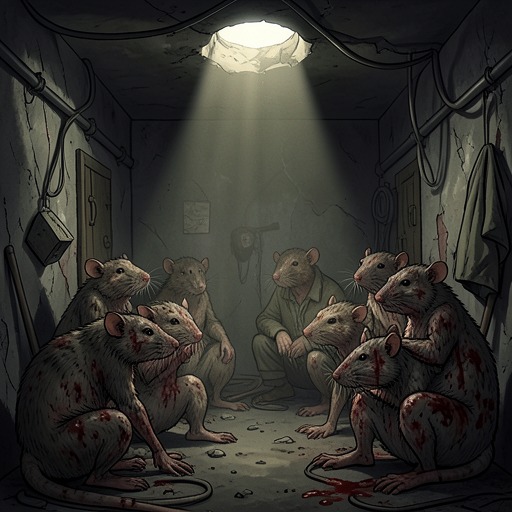
Hamnpork’s capture and assignment to the rat pit
The Amazing Maurice and His Educated RodentsHamnpork’s capture and assignment to the rat pit is a reversal in which a rescue attempt becomes the means of his confinement. When he launches himself at a rat-catcher who has seized Keith, the rat-catchers take him alive; after seeing him prevail in a trial against two caged rats, they choose the pit as his destination. The episode exposes the rat-catchers’ practice of turning captured rats into entertainment and places Hamnpork’s old anger and fighting skill inside a system designed to exploit them.
Circumstances of the Capture
Hamnpork enters the scene as an unexpected defender. Keith is struggling to recover when a grey figure leaps from the top of the rat cages and attacks the rat-catcher holding him. Maurice initially reads the sudden intervention as the sort of timely rescue a story would promise, and assumes that Hamnpork has come to save the day. But the rat-catcher catches Hamnpork and holds him away from reach. Hamnpork twists in his captor’s grasp, while the man, having received the interruption rather than lost control of the situation, regards the rat as an interesting fighter.
The capture takes place as the rat-catchers are also securing Keith and Malicia. One orders Keith to take the two humans to another cellar, specifying a proper door and lock, and no convenient trapdoor. The command shows that the captors have recognized how the cellar’s exits might be used and intend to prevent another escape. Hamnpork, however, is not treated simply as a nuisance to be removed. When another rat-catcher suggests squeezing him, his colleague rejects the idea: the display of fighting ability has made Hamnpork useful to them.
From Captive to Pit Fighter
The rat-catchers test Hamnpork by putting him into a special cage with two other rats. They report that those two are the last survivors of a group of six, and the men anticipate that the pair will be vigorous. Hamnpork faces them alone. The narrative explains his reaction through accumulated fury: for months he has been angry at humans, poisons, traps, the younger rats’ lack of respect, the pace of change, and his own aging. Faced with hunger and fear in the cage, that anger becomes the force behind his response.
Yet the episode presents Hamnpork as more than an angry animal. The two opponents are young, inexperienced, and without tactics; Hamnpork is still strong and knows how to fight in the confined conditions of a cellar. His victory is swift. The other caged rats recoil, registering the force of his attack, and the rat-catcher admires Hamnpork’s cleverness. That praise does not offer protection or freedom. It is immediately converted into a decision about what the captors can make him do: Hamnpork will go to the pit.
The rat-catchers’ choice distinguishes Hamnpork from a captive they mean to dispose of at once. His skill gives him a different role, but only within their business. A capacity that might have defended his people or helped him survive is recognized by his captors as a commodity. The episode therefore turns apparent strength into a further danger: Hamnpork’s successful resistance makes him more valuable to the men who have imprisoned him.
What the Pit Means
The later explanation of rat-coursing clarifies what the assignment entails. Maurice describes a ring set up inside a barn, with dogs released among rats brought there alive by the rat-catchers. The rats run in confusion rather than fight as an organized group; the contest is arranged for human spectators, and the rats sent into the pit are not expected to come out alive. Hamnpork’s destination is thus not a neutral holding place or a test from which he can expect release. It is a venue where captive rats are used against dogs for amusement.
That account also makes clear why the Clan has not heard of rat-coursing. The rats who enter the pit do not return to tell others about it. The system hides its own evidence by consuming its victims, while the rat-catchers’ control of the cages and cellar keeps the prisoners from learning what awaits them. Hamnpork’s assignment connects the cellar’s confinement to this wider exploitation: the capture is not an isolated act of cruelty, but part of an operation that transports living rats into a deadly spectacle.
Significance in the Wider Conflict
Hamnpork’s response to captivity draws on tensions already present in his leadership. Earlier, he had viewed Dangerous Beans’s use of a candle with suspicion, while Dangerous Beans argued that controlling fire could help the Clan declare itself separate and united. Hamnpork’s discomfort with change and his resentment of younger rats help explain the anger that surfaces in the cage; at the same time, his decisive action shows that experience and tactical judgment remain real strengths. The scene does not resolve the conflict between his traditional authority and a changing Clan. It subjects that conflict to a more immediate threat: the rat-catchers’ power to imprison and use rats.
The pit also sharpens the contrast between individual courage and collective action. Hamnpork can defeat two opponents in close quarters, but his individual fighting ability cannot by itself undo the human system that captured him. Later, Darktan’s questions about whether the rats fought the dogs prompt Maurice to explain how fear can turn many rats into a panicked mob, unlike a group capable of coordinated thought. Hamnpork’s capture therefore belongs to the larger struggle over whether the rats remain victims of fear and confinement or act together as the Clan. The event’s decisive irony is that the rat-catchers recognize Hamnpork’s strength accurately, but understand it only as material for their pit.